The Sound of Music is hands-down my favourite musical of all time, not least because my grandad watched it with us at least once a week when we came back from nursery, resulting in an annoying recitation of well-loved dialogue any time we watched it again as a family. Recently, my husband got us tickets to watch a live show of The Sound of Music. I was suitably excited. We left our son with granny and his aunties, and off we went to the New Theatre in town to enjoy this classic. I had to hold back tears, but I wasn’t sure if it was from nostalgia, excitement, or just disbelief that I get to see my favourite musical in person!
Seeing something live makes you view it in a different perspective. Everything is so fresh, so present. This viewing also made me realise that we can extrapolate a few gospel themes from the story. I decided to jot down a few thoughts which turned into a full-fledged essay, which is best read with Climb Every Mountain playing in the background!

Music, Harbinger of Joy
You can’t think of the Sound of Music without humming a few bars of Do-Re-Mi or So long, Farewell. Towards the beginning of the film, it was revealed that the Von Trapps had not sung since the death of Georg’s first wife. It was Maria who brought it back to their life. It was Maria, the encourager, the bringer of joy, the governess who exudes motherly warmth, who reminded them of the delight in song.
Interestingly, the Baroness von Schraeder doesn’t sing. This is thematically consistent: she was the anti-Maria, for she brought with her a cosmopolitan glamour and that seemed to pollute the wholesome family life of the Von Trapps – she was even willing to accommodate the looming Nazi regimes in the name of safety. The ball she requested was supposedly an occasion of merriment and celebration, but she took the opportunity to get rid of Maria, whom she saw as her rival who stole away precious attention from Georg. (My sister and I would say: What a snake!)

Unlike other musicals, the characters in The Sound of Music are aware of their own singing. For them, joy and resolution aren’t far from where music is. Perhaps it reflects the human yearning to express oneself with something deeper than words, something that resonates more with the soul than prose or poetry. It is no coincidence then that at climactic moments of Israel’s history, God’s people choose to use song to express their emotions. Moses at the Red Sea (Exodus 15), David at the end of his reign (2 Samuel 23), Hannah’s song of praise (1 Samuel 2), Mary with her song of Praise (Luke 1), Jesus and His disciples at the Last supper (Mark 14), Paul and Silas in prison (Acts 16) all sang. The 150 songs recorded in the Psalms captured the breadth and depth of human emotion and were quoted and sung by Jesus Himself. Song is one of God’s gifts to us. When we don’t have the words to say what we feel, God has provided even poetry and songs for us in those dark moments. Maybe music doesn’t sufficiently plunge the depths of human emotion. But it certainly comes close!
Constant, Relentless Invitation
Being at the tail end of a long line of governesses for the Von Trapp children, Maria was at the receiving end of several well-rehearsed and fine-tuned pranks, such as the incident of the frog-in-the-pocket, and the dinner-time pinecone, both of which elicited Maria’s horrific reactions and delighted the mischievous children. They made it very clear that they didn’t need a governess. But why did the children warm to Maria? Possibly it is because of her graceful response to the captain when he enquired after her reactions to such pranks. That was the first invitation she extended: an invitation to honesty and reconciliation.
Maria didn’t stop inviting them though. When Liesl climbed in through her window after a secret meeting with Rolph, she invited her in and gave her a nightdress to wear in place of her soaked dress. When a great storm hit and the children were scared, she invited them all in to her room and cheered them up. When they were all out in nature she invited them to sing and gave them the gift of music. When the Captain came back with Max and the Baroness she invited the children into the world of puppet shows and joyful tunes. In short, Maria never stopped inviting the children into her world of song and merriment.
Inviting others in, especially those who are cynical and hostile to what you stand for, is embodying Christ. Christ came to those whose entire lives were built around rebellion against Him, and yet He stretched out His hand and invited them to follow. One can only do that if one has something better to offer. For Maria, she knew that the children need love, and she offered love. For Christ, He knows we have nothing and He has everything to offer. And that is why He stretched out His hands to reach into our desperate, mucky lives, to offer us what is infinitely better than we can imagine. And that’s where the comparison stops, really. Maria didn’t really have to sacrifice much to stay with the Von Trapp children – after all, she stayed to marry the love of her life!
Subverted Hopes – Something Better
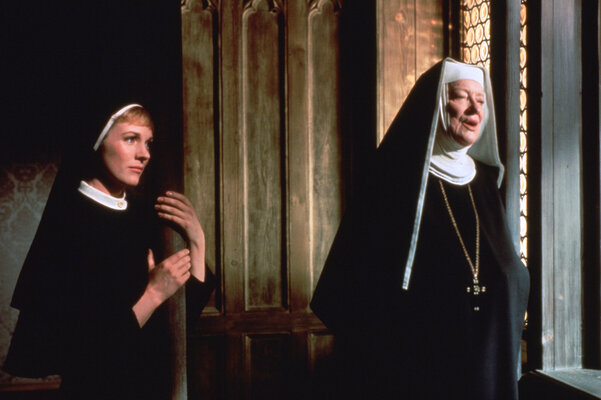
One of the most powerful scenes in the entire film (according to my very objective opinion – not!) is the one where Maria confided in Mother Abbess about her feelings for the Captain, but also her fears about leaving the Abbey and ultimately leaving behind her vocation as a nun.
I remember learning the words in primary school and thinking to myself, I can’t believe they made us learn the most boring song in the entire musical. Now, fifteen years later, I have gained a bit more appreciation for these words of wisdom:
Climb ev’ry mountain,
Ford ev’ry stream,
Follow ev’ry rainbow
Till you find your dream.
A dream that will need all the love you can give
Ev’ry day of your life for as long as you live.
With these words Mother Abbess encouraged Maria to go and give every bit of love that she can for this man she hoped to marry. Shortly after this scene, we see Maria walking down the aisle with a dazzling white dress, between pews of naval officers and well-dressed ladies, in a gloriously grand cathedral, to the choir singing the comical words: ‘How do you solve a problem like Maria?’ Maria chose the vocation of marriage, one which she had not planned for herself. This assignment from God couldn’t seem farther from what she would have dreamt up for herself, but it is no less important or serious.
Of course, this dilemma runs on throughout the whole film. Individuals made their choices, but they could not escape those larger, mysterious forces which were at work around them, in them, for them, against them. Rolph made his choice to join the enemy. Ever the opportunist, he saw the gap, and he filled it. His career success was a measure of his moral failure. Yet it was the opposite for Maria. She seemed to have failed in her assignment as a nun. Although, who was to say that the Lord didn’t sovereignly bring about the situation where she could realise what she was truly meant for – marriage to the Captain and motherhood via the Captain’s children? She faced the momentary pain of subverted expectations, of dashed dreams and ambitions, but she tasted the joy of being obedient in what she was truly called to.
I dare to say that what Mother Abbess refers to as ‘dream’ differs drastically from what we call our dreams.
A dream that will need all the love you can give
Ev’ry day of your life for as long as you live.
We mean ‘dreams’ to be ambition, self-actualisation, self-determination. But for Mother Abbess, a dream is something you pour yourself out for. It is a life-long self-sacrificing service. That’s what love is. My mind wanders to think of the ways where Jesus was described as poured out, emptied, for our sakes.
For even the Son of Man did not come to be served, but to serve, and to give his life as a ransom for many. (Mark 10:45)
In your relationships with one another, have the same mindset as Christ Jesus
Who, being in very nature God,
did not consider equality with God something to be used to his own advantage;
rather, he made himself nothing
by taking the very nature of a servant,
being made in human likeness.
And being found in appearance as a man,
he humbled himself
by becoming obedient to death—
even death on a cross! (Philippians 2:5-8)
Subverted hopes (the Cross) bring greater glory (the Resurrection). Subverted expectations (an emptied servant king) bring greater joy (a King who reigns with those whom He redeemed). This seems to be the way that God orchestrated His grand story of redemption, so who are we to scorn subverted hopes? It is a joy to encounter the disappointment of subverted dreams (as painful as that is, from personal experience) as we know that His purposes are always higher than ours. Perhaps, just maybe, His ways may be better than we had hoped for ourselves.

Sing on…
As you can already tell, I truly love the musical to bits, and I have probably spent too much time thinking about this. (Kids would say, it’s not that deep!) I hope you will join me as I go about my day whistling out-of-tune renditions of ‘Nothing Comes from Nothing.’ May we remember the Creator, the master Composer of the sounds of music. May we rejoice mightily as we weave in and out of harmony to His glorious symphony.

 the migrant wife
Leave a comment