Lots of action can get lost in the books of Kings and Chronicles. Kings and nations being in sin. People not following God. Everything is bad. We are all waiting for Jesus.
In one sense, the pining for Christ is truly palpable. After all, God had promised a Messiah, but reality did not seem to point to the fulfilment of that promise. However, we forget tha
t in God’s wise revelation, He works everything, big and small, for His purposes. None of these years were wasted. If anything, it shows us the patience of a tender God, showing up in the least likely of places, always keeping for Himself a faithful remnant in face of impossible circumstances.
In the historical account surrounding Jehoiada and Jehosheba, the literal bloodline of Christ was saved because of the humble service of a couple who feared God. Let us dive into their story, from the beginning.
Risking it all to Redeem the Rightful Heir
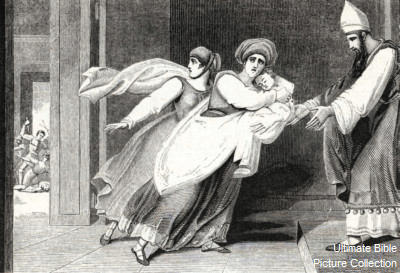
King Ahaziah of Judah followed the evil ways of King Ahab. His mother Athalia egged him on. (2 Chronicles 22:3) God Himself brought Ahaziah’s downfall (v7) after which Athalia went on a killing rampage throughout the entire royal family to secure for herself kingly power. Verse 11 starts with almost a twinkle in the author’s eye:
But Jehosheba, the daughter of King Jehoram, took Joash son of Ahaziah and stole him away from among the royal princes who were about to be murdered and put him and his nurse in a bedroom. Because Jehosheba, the daughter of King Jehoram and wife of the priest Jehoiada, was Ahaziah’s sister, she hid the child from Athaliah so she could not kill him. He remained hidden with them at the temple of God for six years while Athaliah ruled the land. (2 Chronicles 22:11-12)
That last verse of the chapter undersells how much devastation consumed the land and its people when wicked Athalia ruled, and in contrast the hope of redemption that was hidden literally in the bedroom in the temple.
Why did Jehosheba do this? One can only speculate. Neither the account in 2 Kings nor the one in 2 Chronicles specified her motives. But we can guess that it might have something to do with knowing God’s promises. After all, she would have risked her life in hiding the young king Joash, so her motivation would have to be a pretty strong one. Possibly, she could have learnt about God’s promises to David about an everlasting kingdom and the Seed from whom God’s favour will never be withdrawn. (2 Samuel 7). She might not have anything specific in mind, but possibly, she knew that David’s line was God’s way of fulfilling His national (even cosmic) purposes and so she acted in faith.
Their own part… for God’s big story
One thing that struck me was how Jehoiada and Jehosheba worked together as a team. In the first few verses of 2 Kings 11, Jehoiada’s name wasn’t even mentioned. It was as if rescuing the young king Joash was Jehosheba’s thing. What a woman! Perhaps she was not considered for rulership, despite being daughter of King Jehoram and sister to King Ahaziah, but that did not stop her from exercising her faith and preserving the line of David.
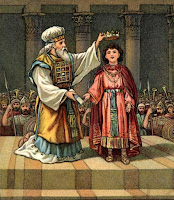
It was only after verse 4, when the action started, that Jehoiada came onto the scene. Gathering men at the Lord’s temple, he managed to reveal the rightful King Joash, killed Athaliah at the palace gates, set up a covenant between the king and his people, and purged evil and idolatrous practices in the land. (2 Kings 11:4-19) He was a man of action and knew what the Lord had commanded. The chapter concludes with a sigh of relief:
All the people of the land rejoiced, and the city was calm, because Athaliah had been slain with the sword at the palace. Joash was seven years old when he began to reign. (2 Kings 11:20-21)
The account in 2 Chronicles 24 also shows that under Jehoiada’s tutelage, Joash oversaw the massive temple repairs and even used the surplus to make articles for service in the Lord’s temple. His good works enabled people to praise and serve God.
However, after Jehoiada died, Joash turned to evil ways again, worshipping idols, abandoning God, and ignoring prophets. (2 Chronicles 24:18-19) It was almost as if Jehoiada was the only voice of reason, the only person who stood between him and his father Ahaziah’s wickedness. The evil counselors and court officials waited in the wings for the death of the godly man Jehoiada, to pounce on impressionable Joash. (2 Chronicles 24:17)
Without his trustworthy counsel, Joash’s heart was so hardened that he killed Jehoiada’s son Zechariah for reminding him of God’s ways. With his dying breath Zechariah said, “May the Lord see this and call you to account” – and He did. The very officials who led him astray conspired against him for murdering Zechariah, and when he was weakened by an invasion by the Aramean army, killed him. What a sad ending to Joash’s life:
Because Judah had forsaken the Lord, the God of their ancestors, judgment was executed on Joash. (2 Chronicles 24:24)
Both Jehosheba and Jehoiada were courageous in their own ways. This story is often told, as I recall, as celebrating girl-power. ‘Three cheers for women having agency!’ But I don’t think this is what the story is about. The writer of the story was not interested in elevating Jehosheba, a king’s daughter and a high priest’s wife; rather, the writer showed that even in the messed-up nation of Judah, where hope seemed all lost, the small ways of small temple bedrooms and insignificant wet-nurses hold the hope to God’s fulfilled promises. Whether it was Jehosheba’s dramatic rescue or Jehoiada’s show of might and godly determination, God had His faithful remnant where He wanted them to be, and by their devoted action they saved the bloodline of the Rightful King – Jesus.
Don’t look at me. Look at Him!
There is some discussion about Jehoiada and Jehosheba’s marriage. Jehoiada is a priest, of the tribe of Levi. Jehosheba was a princess of the line of Judah. Neither writers of Kings nor Chronicles gave a commentary on whether this was good or not. Some point to Lev 21:14 for support to say that Jehoiada should not have married Jehosheba:
He [the priest] must not marry a widow, a divorced woman, or a woman defiled by prostitution, but only a virgin from his own people (Leviticus 21:14)
However, here it only says ‘his own people’ and not ‘his own tribe’ and perhaps it could have been taken to mean his own people, Israel.
Regardless, their marriage was one that the Lord used. Again, this wasn’t a “grassroots victory” kind of story. The writer wanted the reader to feel how rotten to the core this nation was. But God. He preserved the child who would be the forefather of the Messiah. He kept a faithful priest and his wife who would do the valiant thing in face of child-murdering evil. He poured His Spirit on the child of this godly couple who was faithful to God’s word even to death.
Their ministry didn’t point to themselves. Jehosheba had nothing to gain from rescuing this child. From the text, Jehoiada used his position as political counselor and high priest to point the nation towards a right relationship with God, rather than usurping power from the king for personal gain. Humility is a true marker for faithful, godly service. Humble service, however, did not mean mediocre service. Rather, truly humble service aims for excellence and perfection for an excellent and perfect God. Jehosheba rescued the young boy and made all the preparations and provisions, at great personal cost. Despite Joash’s later rebellion, Jehoiada was faithful to help Joash establish a godly rule in his earlier years.
‘It could have been me’
Often when people read stories of heroics, they think to themselves, ‘it could have been me.’ Cue daydreams of standing on a platform with a gold medal in front of a cheering crowd, or televised interviews in front of a roar of questions from journalists waving microphones. After reading this account, we’re tempted to think: I could have done what Jehoiada and Jehosheba did.
Perhaps we could have. But the Lord has not called us to that. He has called us to faithful and bold living now.
Even so, we ought to think: Jehosheba and Jehoiada point us to God. Not only physically in Christ’s lineage… Jehosheba greatly risked her personal safety and status, to save Joash, son of an evil and godless king (2 Chronicles 22:3). Jehoiada greatly risked his status as priest, and installed an ungrateful king Joash as ruler over Judah, guiding him and teaching him, only for him to abandon his ways after his death. What did they get in return? Joash the faithful, the godly, repaid them triple for their mercy? No: they got Joash, the murderer of Zechariah, their son, for his faithful and godly counsel.
Their story reminds us of the big story. God gave His one and only Son, to save an evil and godless people, steeped in sin, only for them to kill Him on the Cross. Jesus gave up all He had (Philippians 2:6-8) and took on obedience to death on a Cross, to save people so thoroughly steeped in sin that their reaction to this extraordinary grace was to reject Him.
So, yes, ‘it could have been me’. Joash could have been me. But the Lord has lavished His grace on us that we might not despise Him. We have grace upon grace – just as Joash did – and He waits patiently for us to return. He delights in our Godward hearts, wandering and weak as they might be at times. He smiles when we rely on His Spirit to come to the Father Himself through His Son. And may we be blessed knowing that He has paid the price for all our evilness, and has given us new life that we may know Him. There is no condemnation – the rescue plan has succeeded. We are free, and one day in the New kingdom, not this old one, we will reign with Him.

 the migrant wife
Leave a comment