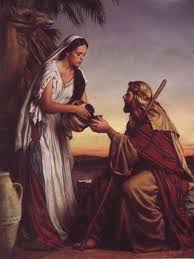
I love a Biblical love story. In a sense, the whole bible is a love story in that God pursues people, that people are invited and embraced and built up purely from His extravagant grace. But I am especially amazed by the love story that took place between Isaac and Rebekah. Instead of describing the “love at first sight” scenes that us modern rom-com viewers are so enticed by, the servant who represents the family to find a bride seemed to be at centre stage in the account of the pursuit. He is the wing-man of all wing-men. He seemed to leave the scene just as the drama was all about to happen – the drama of the wedding between Isaac and Rebekah, the family from whom Abraham’s many descendants will come.
Man of Prayer
Keen for his son to have a wife from his own home country, Abraham charged his senior servant and put him under oath, to go back to where he came from, and find a willing wife that is suitable for Isaac. Interestingly, the word ‘oath’ is repeated in the first section. God had promised with an oath to Abraham that the land will belong to his offspring (v7), and the servant swore an oath to Abraham to carry out his business of finding a wife for Isaac (v9). This was a story of promises. It is as if the writer of the account was saying: God is faithful, and He will carry out His promises, because He was under oath. And He will help this servant carry out his promises to his master, as he was under oath, too.
This servant probably knew full well the gravity of his assignment. If he was as neurotic as I was, he would have thought: God’s promises depended on this. Abraham has to have offspring – Isaac must have a wife in order to have children, in order to carry on Abraham’s line, in order for Abraham to see God’s promises fulfilled… God’s faithfulness depends on me.
But thankfully, this servant knew better. Before he was doing, he was praying.
12 Then he prayed, “Lord, God of my master Abraham, make me successful today, and show kindness to my master Abraham. 13 See, I am standing beside this spring, and the daughters of the townspeople are coming out to draw water. 14 May it be that when I say to a young woman, ‘Please let down your jar that I may have a drink,’ and she says, ‘Drink, and I’ll water your camels too’—let her be the one you have chosen for your servant Isaac. By this I will know that you have shown kindness to my master.”
He prayed a personal prayer. He knew who he was praying to – the God who revealed himself to his master. It strikes me that prior to this, there was no biblical account of God revealing himself personally to Abraham’s servant, but only Abraham (and Sarah, from behind the curtain). But this servant knew enough to call upon the Lord’s help in this difficult task!
He prayed a particular prayer. His prayer was specific. It was as if he was stacking all the odds against this mission being a success. Meeting a woman at the well, who was willing to spend an hour of backbreaking labour fetching water for the man and also his camels? The chances seemed very slim. But he was looking for a woman with a generous heart and virtuous character, and so he prayed boldly for it.
He resolved that any success in his mission would only prove that God has been kind to his master, not his personal competency, or fortune. He knew he was only a chain in God’s purposes. He was keenly aware that this mission was not about him, but about what God will achieve in Abraham’s family. He was glad to be part of it.
And look! God answered his prayer: before he finished praying, Rebekah came out with a jar to fetch water (v15). As he observes her getting the water, offering him a drink, watering his camels, he holds his breath.
21 Without saying a word, the man watched her closely to learn whether or not the Lord had made his journey successful.
He was expectant. How often do we pray our prayers and then forget the contents of our petitions, and when it is answered we retain no recollection of praying for it in the first place. We don’t remember what we pray for, and don’t offer thanks for what we don’t remember. This servant knew how to pray expectantly. He prayed and then watched God at work.
Man of Worship
And God answered his prayer in the person of Rebekah. She fit the bill, perfectly.
26 Then the man bowed down and worshiped the Lord, 27 saying, “Praise be to the Lord, the God of my master Abraham, who has not abandoned his kindness and faithfulness to my master. As for me, the Lord has led me on the journey to the house of my master’s relatives.”
Hallelujah! Here is an unmarried woman of great character, hospitable, kind, and generous. All the world stopped for the servant as he bowed to the Lord and worshipped Him. Lavish, extravagant praise dripped from his tongue, recalling His kindness yet again. He did not look odd – he looked like a man who knew his rightful place before the God Almighty (el Shaddai) of his master Abraham. His master’s Master had shown himself kindness.
When he retold the story to Rebekah’s family, he said that God was the one “who had led me on the right road to get the granddaughter of my master’s brother for his son” (v 48). He knew that Abraham’s God was the one who led him on the right way – He was there every step and guided him to where he was.
His worshipful attitude was evident throughout the chapter. Not only was he worshipping God when he bowed down, he worshipped God with his sincere service to Abraham. He knew that if he was successful, God was behind it. The servant didn’t take centre stage – God was the Main Character. I wonder how his LinkedIn would look. Perhaps it would say: A servant of Abraham, whom God has given success because of His unfailing kindness to my master. I don’t think that would be far from what he told Isaac after his long journey (v 66).
Man of Single-Minded Service
Abraham’s servant was a doer. He carried out his commands with such heart and fortitude. When it came to the crucial moment, after he had enjoyed the hospitality of Bethuel and Laban’s family, Laban and Rebekah’s mother stalled: why don’t she stay ten days or so? As if to say, “we think this might not be a great idea after all”. The servant was anxious to go back and report back to his master, either of good news of success or bad news of disappointment. They called Rebekah out to ask her what she wanted – and she said she wanted to go – hooray! The servant seemed very forward, even in today’s western standards. One asking for another’s daughter / sister’s hand in marriage for one’s master does not tend to demand immediate answers from her family. However, he was anxious to know the result of the trip. He wanted to know for his master’s sake.
The entire narrative is bookended with the servant’s concern for his master and Abraham. In verse 2 we see that this servant took charge of everything Abraham had. This reflected his trustworthiness – Abraham was a wealthy man and it was up to this person to steward his wealth well. We also see that “the servant put his hand under the thigh of his master Abraham and swore an oath to him concerning this matter.” (v 9) The servant solemnly swore that he will do all he can to carry out this mission his master had tasked him. Skipping to the very end of the chapter, the servant introduced Rebekah to Isaac, whom he identified as “his master”, to whom he also relayed all he had done on his journey. I believe this was a deliberate choice of the author: the servant was sent by his master, and he was received by his master.
His story reminds me of Paul’s exhortation to Timothy:
No one serving as a soldier gets entangled in civilian affairs, but rather tries to please his commanding officer. (2 Timothy 2:4)
How often do we keep one eye on our sphere of service, and another eye on what our neighbour is doing! How often do I say to myself, I wish I had the assignment that they have. But God has called me to one thing, and that is faithfulness in my circumstances. Abraham’s servant knew this well. He worked at it with all his heart. He knew his God-given task and relied on God-given strength to complete it.
Invisible Man – Blessed by God!
In the very start of the story, we were told that God had blessed Abraham in every way (v 1). Even the servant himself acknowledged that his master Abraham was abundantly blessed by God. (v35) As it turned out, this servant was so fixated on serving and blessing his master, that he didn’t realise that he himself was also blessed by God, as Laban rightly announced. (v31)
What extraordinary favour! He wasn’t part of Abraham’s direct line. He wasn’t even named in the account. But he was called ‘blessed by God’. We, the Gentile church, have much in common with him. We aren’t descended directly from Abraham (-Isaac -Jacob). And yet we are blessed by Jesus, “who has blessed us in the heavenly realms with every spiritual blessing in Christ.” (Ephesians 1:3) May we be encouraged by God’s faithfulness to his people and give Him praise, even when we are not direct material benefactors of such blessing. And rejoice in the great blessing that we do have in Christ!!

 the migrant wife
Leave a comment