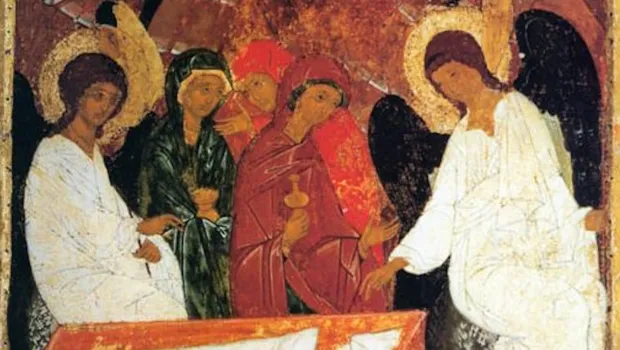
Joanna of Chuza always fascinated me, not least because she had a pretty name. She first was introduced as one of the women healed by Jesus in Luke 8. She was also one of the first witnesses to the empty tomb on Resurrection Sunday in Luke 24 (depicted by the image above).
She has been the subject of much speculation, but I hope to study what the Scriptures do say about her rather than filling in the gaps on what the Bible is silent about. In spite of her rare appearances in the Gospel narratives, I do believe she can teach us not only about her quiet faithfulness, but about the God whom she served.
Unseen labour
The Bible introduces Joanna as one of the women who helped support Jesus and his disciples’ itinerant ministry out of their own means (Luke 8:1-3). She, along with the other women, Mary Magdalen, Susanna, and others, worked and provided, perhaps out of the surplus after providing for their own families.
In many seasons, we find ourselves doing the ‘invisible’ things. Making meals, helping out at creche, teaching and training children at home are all important, but nobody sees it. Many times I found myself wondering, if only I could be the one up front at church, leading the congregation in worship. Or, if I’m feeling extroverted: if only I could be on the outreach team, having interesting conversations and telling strangers about Jesus. Nobody keeps track of the times I led (little) people in prayer at home, or the other mums I’ve spoken to by the swings / at softplay. We then become jealous of other people’s ministry opportunities.
When we zoom out of the passage on Joanna and the other women, we see that Jesus and the Twelve traveled about ‘from one town and village to another, proclaiming the good news of the kingdom of God.’ (Luke 8:1) They were doing exciting things, telling people that the fulfillment of the Old Testament prophecies were at hand: “The Kingdom is almost here, so be prepared.” I can imagine the Twelve coming back with the thrill of large crowds (Luke 8:4-8), even the excitement hearing Jesus explaining his parables (Luke 8:9-15). Joanna and the other women, on the other hand, were doing the invisible jobs, and I wonder how their hearts were? Were they overjoyed for serving their Messiah? Were they prayerful as they went about their business, grateful for the opportunity to serve? Did they have faith that they, too, were playing a part in the kingdom of God, and that the Father saw their work done behind the scenes?
We aren’t told. But we are given a glimpse of what motivated these ladies to do what they did. Verse 2 said that these women had been delivered from evil spirits and diseases (the most prominent of the women being Mary Magdalen from whom seven demons had come out). We mustn’t think that Joanna was overshadowed by the spiritual victory of Mary Magdalene, although the order of the names does give an indication of who the ‘leader’ of the women was. Instead, Joanna herself had experienced the healing power of Christ Jesus. We weren’t told how she was healed, but we know that she decided to dedicate her life and business to supporting Christ’s ministry.
Encountering Jesus, experiencing His divinity and compassion through His ministry (and for us, even death and resurrection), leads one to a place of humble service. This is the cure for ministry FOMO, or long-festering bitterness that comes from the ‘mental load’ many of us carry. I hesitate to read too much into this, but Joanna might have been living out what Paul exhorted us to do:
Therefore, I urge you, brothers and sisters, in view of God’s mercy, to offer your bodies as a living sacrifice, holy and pleasing to God – this is your true and proper worship. (Romans 12:1)
..Then They Remembered
Joanna was also one of the women who went to Jesus’ tomb on Easter Sunday very early in the morning. According to Luke, these women were the first to hear of the news that Jesus lives! Understandably, they were absolutely terrified when they saw the men dressed in white. (As an aside, most people who saw heavenly beings cried out in terror. Even John, the beloved disciple, found the angel he encountered so majestic and awesome that he bowed down and worshiped him. He then got rebuked by this angel. Frightening stuff.)
What they heard from these men was no less terrifying than their appearance:
“Why do you look for the living among the dead? He is not here; he has risen! Remember how he told you, while he was still with you in Galilee: ‘The Son of Man must be delivered over to the hands of sinners, be crucified and on the third day be raised again.’ ” (Luke 24: 5b-7)
Hallelujah! Together we rejoice with the women, perhaps with less trembling than we ought, that Jesus Christ has risen from the dead. Jesus had prepared them by telling them before the fact. They had all they needed to be comforted and reassured. But perhaps in the confusion and grief they forgot.
Then they remembered his words (v8). This earth-shaking, curtain-tearing, tombstone-removing miracle did not happen in a vacuum. It was prophesied by the prophets of old and taught by Jesus himself, and in that moment, they remembered and so understood.
Much of our unbelief is basically spiritual amnesia. Many times I catch myself feeling anxious about an area that God has previously worked in me in the past! I worry about not having friends when we move to a new place, forgetting that God has always provided kindred spirits wherever I went. I worry about accommodation, forgetting that every time we moved, God provided the right thing at the right time. In addition to this, we forget His word which He has so mercifully given, in which we also find encouragement and assurance.
Remembering is an action. After the Lord gave the Law to His people Israel, this instruction was given:
These commandments that I give you today are to be on your hearts. Impress them on your children. Talk about them when you sit at home and when you walk along the road, when you lie down and when you get up. Tie them as symbols on your hands and bind them on your foreheads. Write them on the doorframes of your houses and on your gates. (Deuteronomy 6:6-9)
Notice how the actions encourage memory: impress them… talk about them… tie them as symbols… write them… Not just memorise and try to remember them with all your might, but actively engage your body and mind in God’s Word. Perhaps that is a good starting point for us as we ‘remember’ with Joanna, and the other women. We do have an advantage over the women then – all who believe have the indwelling Holy Spirit who reminds us of what Jesus has said (John 14:26). May we remember, by the help of the Spirit, and rejoice!
Heard, Believed, now Tell
When they came back from the tomb, they told all these things to the Eleven and to all the others. It was Mary Magdalene, Joanna, Mary the mother of James, and the others with them who told this to the apostles. But they did not believe the women, because their words seemed to them like nonsense. Peter, however, got up and ran to the tomb. Bending over, he saw the strips of linen lying by themselves, and he went away, wondering to himself what had happened. (Luke 24:9-12)
I remember being terrified at Youth, when we went out ‘witnessing’ – basically telling people on the streets that Jesus Christ is risen, and we have a hope of resurrection! That was basically what these women did. No doubt they were terrified, having seen angels and all, but they were probably also worried what the Eleven would say about this.
None of that seemed to have stopped them, though. They heard what the men told them. They believed. They told others. This begins the chain of hearing, believing, telling, all the way down through the explosion of the church, the spreading of the gospel throughout the nations, through families and generations. I am a believer in Christ today, because somebody heard the gospel, believed it, and told me.
Later in the New Testament, Paul says:
How then will they call on him in whom they have not believed? And how are they to believe in him of whom they have never heard? And how are they to hear without someone preaching? And how are they to preach unless they are sent? As it is written, “How beautiful are the feet of those who preach the good news!” But they have not all obeyed the gospel. For Isaiah says, “Lord, who has believed what he has heard from us?” So faith comes from hearing, and hearing through the word of Christ. (Romans 10:14-17)
Here Paul asserts that belief in Christ comes after hearing from God (verse 17). But it does not guarantee the reverse: hearing the word of God does not always result in belief, as Isaiah was quoted lamenting the meagreness of belief among the people of Israel. Obviously, we have no control over who responds and who doesn’t. Yet, this is the way that the Lord has designed for faith to happen – people hearing, believing, and in turn telling other people so they can hear too.
I wonder if this makes us cringe. The last thing I want to do at the swings is to have another mum give me weird looks for starting a conversation about Jesus! But I have been so encouraged by the unexpected openness in some families in spiritual things. Perhaps I give too little credit to what God is already doing in people’s lives. I think it’s even harder to tell close family and friends about Jesus. The stakes are too high. They know me too well. Joanna and the other women knew the Eleven quite well – after all, they had traveled with Jesus during His earthly ministry. Yet they seemed to think that this was too big a piece of news to not tell them, even if (a) they didn’t believe them and (b) they thought their words were nonsense. Yet out of the Eleven there is Peter (and as we know from the gospel of John, John too) who set out to investigate for themselves, and come to the same conclusions about the risen Saviour. Perhaps there will be Peters and Johns among those whom we tell too. I have yet to find out who those are for me.
Girl-Boss, or Faithful Servant?
Some speculate that Junia (Romans 16:7) could be Joanna of Chuza. I am not sure. Regardless of whether these were referring to the same person, the Joanna in the Gospel of Luke does not primarily show us her qualities as a go-getter, successful businesswoman, or wealthy lady, even if she was all of those things. Hers was a portrait of a keen follower of Christ, enabling His disciples’s itinerant ministry, offering up self-sacrificing service.
Perhaps we long to be caught up in the midst of high-profile events, like witnessing the Empty Tomb. Or perhaps we would like to stay in the background, staying out of the limelight and out of trouble. In either situation, Joanna chose to be faithful – providing when there was a need, and bringing the message when there was one. She served the Lord Christ who healed her, the same Lord who later was raised from the dead, so she might have reasoned that he was worth her faithful service. Maybe that’s what our faith will lead us to conclude too!


Leave a comment