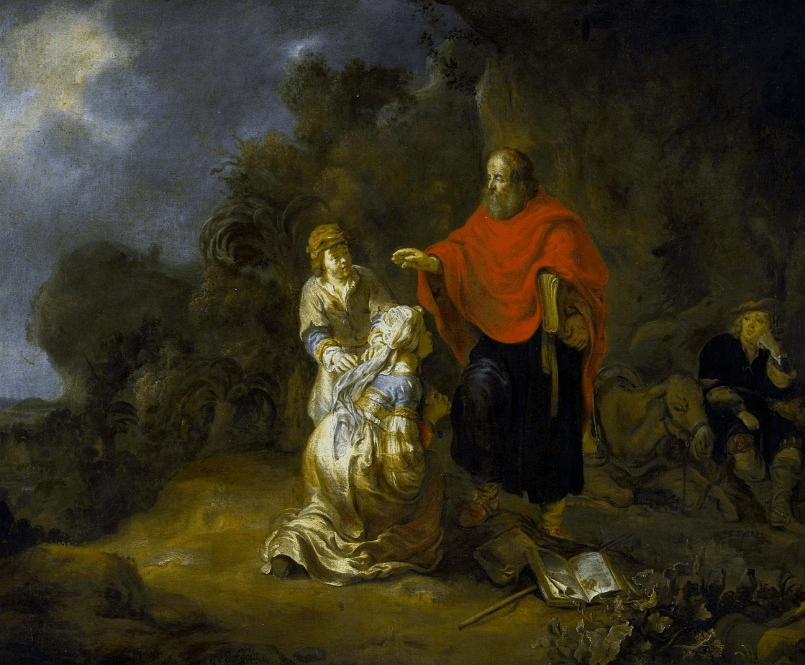
(image: Gerbrand van den Eeckhout, Elisha and the Shunammite woman, 1649)
One reason I believe why Instagram has been so popular is that anybody can look important. Anybody can put up a video and act as an expert in anything. People who would otherwise live in relative obscurity can have a ‘platform’ if they wished. That appeal obviously speaks to most people, which explains the $70.4million brand value of the platform.
The Bible doesn’t seem to be as obsessed about fame and following as we tend to be. Quiet faithfulness is neither showy nor trendy (when in human history has it ever been?). But it seems that even in these normal, slightly broken, slightly shabby lives, God shows up. The Shunamite woman was one who encountered God’s power through Elisha’s ministry.
Perhaps we want to be like her, ‘just a normal girl who sees God work, so people will want to hear what I have to say’. After all, if it weren’t for her story being recorded in 2 Kings, history would have forgotten her alongside with the billions of others who lived their lives on earth from ages past till now. But she probably didn’t start or continue in her faithfulness to be famous. She started with a reverence for God which was displayed as hospitality.
Costly, Extraordinary Hospitality
The Shunamite woman was the picture of hospitality. Having welcomed the prophet Elisha a few times into her home for food, she consulted with her husband and decided to build a furnished room for Elisha so he could stay over when he comes to Shunam. (2 Kings 4:8-10). Her home wasn’t only to her an anchor for her social and family life (4:13), but it was also a channel for her to share God’s blessings with other people, mainly Elisha. The woman, together with her husband, showed hospitality at great material cost.
The woman did this because she knew Elisha was a holy man of God (4:9). Even for us, kindness to God’s people is an act of worship. As Jesus said himself, our service for the most insignificant in His kingdom is received as service to the King Himself. (Matthew 25:40-45) The willingness to sacrifice for hospitality is always linked to the identity of the recipient. The woman thought Elisha was worthy of her expense because he was a man of God. Before you misunderstand, I don’t mean, never show extravagant hospitality towards undeserving people! Rather the opposite: show hospitality to all, because in receiving them, we are receiving Christ who is worthy of all.
It seems the woman didn’t want anything in return. In his thankfulness, he asked her what can be done for her, offering to speak to the king or the commander of the country perhaps, to give her a position in court or a place of honour and wealth. To this, she replied with a contented answer that she has a home among her own people, as if to say, ‘What more could I want?’ (2 Kings 4:13)
Yet the perceiving Gehazi mentioned her childlessness and at once Elisha promised that this time next year, the woman will hold a son in her arms! (4:15-16) She was probably filled with disbelief, as one would, when one suddenly finds the answer to the deepest longing of one’s soul. Nevertheless, she soon bore a child, just as Elisha had said.
When I read the passage again, I realised that the woman never asked. It was Gehazi who had noticed her childlessness. She knew Elisha was a holy man of God; she probably had heard of his previous miracles and how God had been working through him. Yet she never expected God’s power and kindness to be displayed for herself, not even as a reward to her hospitality.
I wonder how often our hospitality is tied up with whether we will be repaid with mercy. Do we continue inviting those who won’t invite us back? Do we do it even when it is costly? As I ponder on this account in 2 Kings, the extra grocery bill pales in comparison with the cost of building an extra room.
A Recipient of Extraordinary Grace
Many know what happened after the woman was granted a child. One day the child died (4:20), after which the woman went to see Elisha, who sent Gehazi to heal the child (4:29-31). Gehazi couldn’t do it, so in the end Elisha came, lay upon the child, and the child came back to life (4:32-25)!
First hand experience of the resurrection! What was she thinking when her child died on her lap? Losing a child is every mother’s nightmare. It doesn’t matter how old or young your child is, grief as a mother probably feels like a bottomless pit of echoless despair – grief unanswered. Imagine what it would have been like for this mother, though, a child born as great consolation to her barrenness, hope from emptiness, only for him to be taken away. She must have thought: I was OK before I had a child, so why did God let this happen? But in God’s providence and wisdom, she had a front-row seat to God’s resurrecting power. Not every mother gets this experience, but the Lord, in His mercy, revealed Himself to her through Elisha’s miracle. Receiving her child from the dead might not have been what she hoped for in her barren years, but it certainly deepened her appreciation for Elisha and also perhaps her awe of the God he served (4:36-37).
Here seems to be a good time to pause and notice: she seemed to be discerning about Gehazi’s character. Many people believe that the first part of 2 Kings was not written in chronological order – in fact, the events with this honourable Shunamite woman might have happened before the episode with Namaan, where Gehazi dishonestly took the money and gifts, which Elisha refused, and then was ridden with leprosy. (2 Kings 5) The Shunamite woman seemed to discern the flawed character of Gehazi and refused to confide in him in her distress. (4:25-26) It was also telling that Gehazi couldn’t raise the boy with Elisha’s staff – it was Elisha himself that God had empowered, and he was the chosen vessel through whom He would accomplish his mighty works.
It seemed that God’s mercy followed her even further than her son’s resurrection. We see her again in 2 Kings 8. After having left the land she was from to escape from a famine (on the advice of Elisha), she lived among the Philistines for seven years. (8:1-2) She then returned to appeal to the king about her land and home, obviously hoping that she could live ‘amongst her people’ again (8:3, cf. 4:12). As it so happened, as Gehazi was describing to the king the miraculous works of Elisha, the Shunamite woman appeared, and was able to testify to God’s work in raising her son from the dead. The king then announced: “Give back everything that belonged to her, including all the income from her land from the day she left the country until now.” (8:6)
Not only was she able to return to her land, but she was also given the income that her land had generated in her absence. Remember when Elisha offered to speak on her behalf to the king or the commander of the army? (4:13) She had refused. But in God’s mercy, even this has been granted to her.
For the rest of her life, she seemed to have returned to obscurity. Did she remain faithful to the covenant God of her people? Did she raise her son telling him about the mighty works God had done in her and his life? We aren’t told. Reading her story, perhaps we think, I would never encounter such marvelous things as she did. But we err seriously when we think this, for have we not been promised that we will be raised from dead to life ourselves? (Romans 8:11) Have we not been offered living hope because of Christ’s resurrection? (1 Peter 1:3) Have we not been promised an inheritance as believers and followers of Christ? (Ephesians 1:11) Our story is yet to be over, and even if most of us live in relative obscurity, we can remain faithful to the One who is Faithful.
Years later…
While the Shunamite woman probably lived in 885-900BC (during the Divided Kingdom), in the first century, Jesus performed a miracle on the other side of Mount Moreh, in a village called Nain. Jesus saw a dead son of a widow being carried out of the town gate, followed by a large crowd, and the mother wept. Jesus told the mother not to cry – and commanded: “Young man, I say to you, get up!”(Luke 7:14) The joy is palpable in the following verse:
The dead man sat up and began to talk, and Jesus gave him back to his mother. (Luke 7:15)
The same resurrecting power of God, only on the other side of the mountain, and only nine centuries later. Jesus was the true and better Elisha. God worked through Elisha stretching out his body on the young man; Jesus commanded the young man to get up. Elisha was a prophet who did God’s work and ministered to fallen kings and the common people; Jesus is the true King and came as one of us, the common people. At the end of his ministry, Elisha died and was buried (2 Kings 13:20); Jesus died and rose again. He is the Resurrection and the Life (John 11:25). Elisha didn’t raise another person during his ministry (though another body touched Elisha’s bones after Elisha died, and the man was raised again – 2 Kings 13:21); Jesus not only raised two in his ministry on earth (Luke 8:40-56, John 11), He also raised many en masse at his death (Matthew 27:50-53), and continues to give new life to those who believe (John 11:26).
If we’re still counting centuries, then twenty centuries later, this miracle by Jesus is still repeatable. His promise in John 11 still applies today. He still asks the same question of us: “Do you believe this?” (John 11:26) And perhaps with Martha before Lazarus’s tomb, we can say:
“Yes, Lord, I believe that You are the Christ, the Son of God, who is to come into the world.” (John 11:27)
And what is fame when compared with the joy of resurrection? What is the thrill of a high-profile life when compared to the honour of reigning with Christ? May we be content and faithful, resting in the knowledge of the Risen Lord and His mercy that follows us all our lives.



Leave a comment