Sometimes I feel it is rather harsh to label people as ‘small people’ in the Bible, as if we ourselves are the big names and we just happened to go sifting through scripture, found a crumb of a person, and tried to understand who they were and what they were about. I don’t mean that they were small – after all, their names have been recorded here for all of us to see and read.
We see these obscure characters, named once or twice, as small, because of the Big God they point towards. With the Psalmist we exclaim, “What is man that You are mindful of him?” (Psalm 8:4) What the Bible records is probably a highlight-reel of their life: we don’t know what they had for dinner on a Tuesday, what their biggest argument with their spouse is, or how their relationship with their parents is (well, sometimes we do know, but not always). And yet, these people could be big in character and faith in their own right. Reading and thinking about these ‘small’ characters help us understand that God uses even normal people like us to fulfil His purposes.
The people we focus on in this piece aren’t small at all. They were mighty warriors and military generals and royal counselors. We hear bits and pieces of their work, but they often get named together. David’s mighty men might have small beginnings, but God accomplished His big purposes through them.
Humble beginnings
The first time we encounter David’s men is in 1 Samuel 22:1-2. David had been persecuted by Saul for a while. He parted ways with Jonathan (who warned him that Saul wanted to kill him). He fled to ask for help from the High Priest Ahimelek, where Doeg also was detained (and later betrayed David – he was one of the Biggest Snakes of All Time).
David then went to Achish king of Gath, hoping to remain in obscurity to escape Saul, only to be recognised by Achish’s servants. So he pretended ‘to be insane’, and then left Gath after Achish, who believed his ruse as a madman, threw him out. David came to the cave of Adullam, and people came to him. His family, and other people who were ‘in distress, in debt, or discontented’ gathered around him.(1 Sam 22:2)
Imagine you were David, after having accomplished never-before-mentioned feats of escape and stealth. You would hope that you could amass a bigger, more experienced army than this ragtag bunch of misfits. Many of the 400 were not named. But it was these people who remained loyal to David and his dynasty, who achieved acts of greatness, and who played a role in his kingdom.
Perhaps we can understand why these men gathered behind David. They were disappointed in Saul, and have heard the great works that David had done. If David was to overthrow Saul’s rule, they wanted to be part of it.
Does it sound similar to Jesus’ disciples to some extent? Jesus didn’t attract the powerful religious or military rulers of the day. John, an unconventional teacher, had prepared the way for him, encouraging people to repent for the kingdom of God is at hand. The people who recognised Jesus as the Messiah were lowly fishermen, tax collectors, women, or people who were sick, or were outcasts. They were waiting for Christ to inaugurate His kingdom and earthly rule, not knowing that He had come to save the world through His blood instead.
And not to discount you and I, dear reader. Jesus didn’t call us to follow Him because we were big names (at least, I admit that I’m a bit of a nobody in the best sense of the word). He came to seek and save the lost. He came for the sinners. Yet unlike David’s followers, Christ’s disciples aren’t memorable because of the things that they achieve for their leader. Jesus’s followers, all through the ages, have been called to deny ourselves and follow Him, to love God and His people. In other words, we magnify His name instead of our own. The names of humble followers might not ever make it to any list of names worthy of mention, but our name is written in the Lamb’s Book of Life – the most worthy list of all.
Risking their lives
Throughout Samuel and Chronicles, we read of the mighty works of David’s men. Thirty-seven of them were named as ‘mighty warriors’. (2 Sam 23, 1 Chron 11)
Josheb-Basshebeth (2 Sam 23:8) / Jashobeam (1 Chron 11:11) was the chief of the Three: Eleazar the Ahohite, Shammah the Hararite, and himself. Their famous exploits were recorded. Eleazar stood his ground despite Israel’s retreat, and fought the Philistines till exhaustion, and the Lord gave him victory. (2 Sam 23:9-10 – and perhaps another instance on a barley field, 1 Chron 11:12-14) Shammah showed similar tenacity in his exploits for David, standing his ground on a lentil field despite most of the other troops fleeing, and the Lord gave him great victory. (2 Sam 23:11-12) Interestingly, though not surprisingly, the Lord was mentioned behind all these victories. Perhaps with David in the psalm he penned, they sing:
“Now this I know: The Lord gives victory to his anointed. He answers him from his heavenly sanctuary with the victorious power of his right hand. Some trust in chariots and some in horses, but we trust in the name of the Lord our God. They are brought to their knees and fall, but we rise up and stand firm. Lord, give victory to the king! Answer us when we call!”
Psalms 20:6-9 NIV
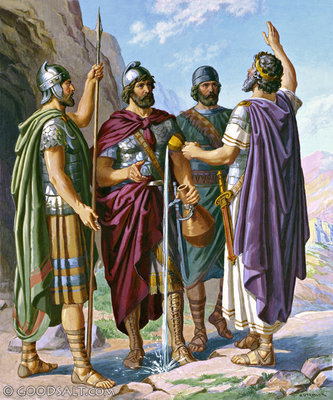
These three might have been the mighty men who, upon knowing David their leader was parched and thirsty after all the fighting, risked their lives to retrieve a drink from the well near Bethlehem gate, and brought it back to the cave in Adullam. (2 Sam 23:13-17, 1 Chron 11:15-19) Nonetheless, David would not drink it, because his men risked their lives for this drink. He said, “Is it not the blood of men who went at the risk of their lives?” (2 Sam 23:17) Because these men risked their lives for him, David saw this cup of water as their life-blood, which symbolised God-given life, and refused to drink it (as is prohibited in the law of Moses). Instead, he poured it out, likely as an offering to the Lord. Their heroic sacrifice for their leader David was symbolically poured out as an offering to the Lord.
Benaiah son of Jehoiada from Kabzeel was not named with the three but done mighty things: killed Moab’s two mightiest warriors, went down into a pit on a snowy day and killed a lion, struck down an Egyptian who was five cubits tall. (1 Chron 11:22-25) He was put in charge of David’s bodyguard.
Abishai has been mentioned many times in the books of Samuel. He was loyal to a point where he was willing to kill Saul in his sleep, only to be stopped by David, of course (1 Sam 26:6-9). In another instance, David was surrounded and exhausted by fighting Philistines, and one of them had a new sword and said he would kill David – almost as if he was about to deal the death blow. See how the author described it: “But Abishai son of Zeruiah came to David’s rescue and killed the Philistine.”(2 Sam 21:17 NLT) He saved the anointed king! He wasn’t one of the Three, but was held in even higher honour and became their commander.
Ittai the Gittite is an honourable mention. He was a foreigner. At the height of Absalom’s rebellion, David, his officials and his household all fled Jerusalem. As the people marched in front of him, David said to Ittai:
Why should you come along with us? Go back and stay with King Absalom. You are a foreigner, an exile from your homeland. You came only yesterday. And today shall I make you wander about with us, when I do not know where I am going? Go back, and take your people with you. May the Lord show you kindness and faithfulness. (2 Sam 15:19-20)
In other words, Ittai had no kinship or familial reason to go with David. And yet, Ittai responded with surprising loyalty: “As surely as the Lord lives, and as my lord the king lives, wherever my lord the king may be, whether it means life or death, there will your servant be.”(2 Sam15:21)
This loyalty to death goes far beyond obedience. Obedience says: I will do anything required by my master. Loyalty says: I will risk everything for my leader. Though we don’t hear much from the rest of the thirty-seven mighty men, we can imagine their devotion was exemplary. (2 Sam 23:24-39, 1 Chron 11:26-47)
Uriah
I thought it was odd that Uriah the Hittite was mentioned in both lists. (2 Sam 23:39, 1 Chron 11:41) After all, David committed adultery with Uriah’s wife, murdered him, then married Bathsheba. As a commentary on David’s actions, 2 Samuel 11:27 states that this had “displeased the LORD.”
Much of the heartache in his life stemmed from the consequences of this intentional sin. God had ordained the consequences of this sin, even if he had removed the guilt from David (2 Sam 12:13) Furthermore, David pronounced a harsh judgment on himself by condemning the rich man in Nathan’s provoking parable: “As surely as the Lord lives, the man who did this must die! He must pay for that lamb four times over, because he did such a thing and had no pity.” (2 Sam 12:5-6) Because of this sin, he would suffer the consequences all his life. Uriah’s name would conjure up memories and regret.
What was the consequence? Death of his sons: his firstborn son (2 Sam 12:18), Amnon killed by Absalom (2 Samuel 13:23-38), Absalom killed by Joab (2 Sam 18:9-18), and Adonijah executed by Solomon (1 Kings 2:13-25).
This wasn’t the end. Violence prevailed in his household: the rape of his daughter Tamar (2 Sam 13:1-12), Absalom’s treason (2 Sam 15-18), Sheba the Benjamite’s rebellion (2 Sam 20:1-22).
Heartbreak and disappointment plagued his days – the consequences of sin, trickling down the generations in David’s household. David probably grieved over this sin many days of his life. Knowing the guilt had been removed from him didn’t mean he could escape the temporal consequences of his actions. Perhaps it was because of this, Uriah’s name was inserted as the last one in 2 Samuel 23:39, a tribute to the righteous man whom David sinned against, the aftermath of which shaped the rest of David’s life.
There is a redemptive element to Uriah’s legacy though. In the genealogy of Jesus, Bathsheba is mentioned in Matthew 1:6. More accurately, the wife of Uriah was mentioned (Matthew didn’t use her name), perhaps to avoid detracting from the magnitude of David’s sin. But through this shameful and complicated affair, came David’s son Solomon, and many generations later Jesus the Messiah. God is an expert in the work of redemption, whether in the personal, national, or cosmic level. He works despite our failings, and even transforms them in His wisdom, and weaves them into His grand plan.
David’s contrite and humble heart before the Lord was evident in Psalm 51. Perhaps throughout his life he would wince at the name Uriah. He didn’t live to see the full story, like how this sin would be covered by the death of the Lord Jesus. He didn’t see exactly how the Seed would come from his lineage. But we do, and we reap the spiritual benefits from God’s mercy to David. We see Jesus enfleshed among us through the pages of our Bible, and we can put our faith in His finished work on the Cross, so that whatever shameful and un-named past we have endured can be washed clean by His blood. We bear our sin no more.
We hear the same announcement Nathan made to David after pointing out his sin of adultery and murder: “The Lord has taken away your sin. You are not going to die.” But we have an even greater assurance of Christ’s forgiveness and present mediation. David knew of an afterlife, as he said he would see his deceased infant son again (2 Samuel 12:23). But we have a surer hope of eternal life, in the presence of Jesus.
Shedding the main character complex
As we journey through the various “small people” in the Bible we marvel at how the LORD uses even small characters. These mighty men did amazing acts for God in their own right. But they were never anointed kings, and most of them don’t get another mention anywhere else in the Bible. Yet they were loyal to God’s anointed one and considered it their duty to serve him and obey him.
Many of us go through life with the burden of the main character. I don’t think it’s exclusively a Gen Z / Gen Alpha thing, for when has self-centred ambition, in its various forms and guises, not been trendy? But here we see that it is a blessing to be the “supporting character”. The Lord uses everyone, from supposed “lead roles” to the smallest “cameos”. After all, followers of Christ are called to deny yourself, take up your cross and follow Him (Mt 16:24). These men were willing to risk everything for their earthly king and leader. Might we be willing to do the same for our King and Saviour?


Leave a comment