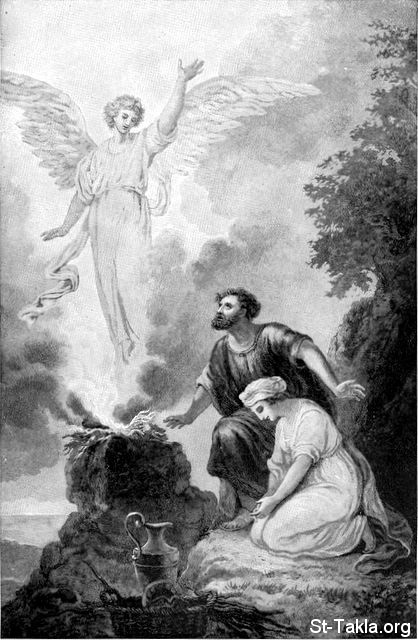
Samson, one of the judges in the Old Testament, seems the complete opposite of who you would think of as a “small character” in God’s story. Being strengthened by God, he was incredibly strong physically. His story was one of drama, romance, backstabbing, and ultimately disappointment. In a way it followed the theme of Judges – the rapid moral and societal decline for a nation walking away from God.
Not many people remember the story of Manoah and his wife, Samson’s parents. I was nervous to write about them because, who wants to write about parents who had disappointing children? That perhaps could be an unspoken fear of many mothers (sometimes mine, dare I confess) – what if my child ends up a failure? I would love to say that the Bible promises that we will never be disappointed in our children, but the Bible doesn’t. There are plenty of good parents with ungodly children in the Scriptures. There are also plenty wicked parents who had God-fearing children. But we must not turn Bible study into hunting for formulae for success (see the piece on Jabez’s prayer.)
We must hesitate to treat Menoah and his wife as prime examples for parenting, for obvious reasons. But we mustn’t also discount their story for what they did. After all, they lived in a pretty hostile environment and were told to do pretty radical things – and they obeyed. And yet, like the rest of Judges, their story is meant to point us toward a greater One who is the perfect Judge, who will never disappoint.
Someone told me…
Manoah and his wife lived at a time where Israel was given over to the Philistines for forty years because of the evil they had done in the eyes of the Lord (Judges 13:1). People around them were doing wicked things and despising the Lord’s command. Not only was there external turmoil to contend with, they also had to face the embarrassing and devastating fact that she was barren. For them, it seemed there was no life, no hope, and they lived with the constant reminder that their people had failed.
Verse 3 is where the story pivots.
The angel of the Lord appeared to her and said, “You are barren and childless, but you are going to become pregnant and give birth to a son.
At once, Manoah’s wife joined the ranks of women who had been barren but received a child from the Lord. With Hannah, Sarah, the Shunnamite woman, and Rachel, she praises the Lord who raises the dead, and gives life to a dead womb. (Rom 4:19) We aren’t told who they were prior to this – did they fear God? Were they faithful? Either way, we can see from the response to the encounter with the Angel of the Lord, that they proceeded from there in faith.
The angel of the Lord gave Manoah’s wife instructions: no fermented drink, no unclean food, her son’s hair shall not be cut, because he is to be a Nazirite. (13:4-5). Not only were they to have a son, but he is going to be the hope of Israel, because he “will take the lead in delivering Israel from the hands of the Philistines.” (13:6). This child was promised by God and was to accomplish God’s purposes for His chosen people. Surely like Mary, she would remember these words and treasure them in her heart. As her son grew up, she must have ruminated over these words and wonder, what is God going to do through my son that He has given me?
But we must not get ahead of ourselves. Manoah, being unsure who this man of God was that his wife was talking to, asked the Lord to teach them how to bring up the child. It is interesting that even on the second appearance of the Angel of the Lord (who, by the way, many think is the pre-incarnate Second Person of the Trinity – Jesus – more later) the message was specifically for Manoah’s wife, not Manoah himself. This was despite having personally asked of the Lord (13:8). Perhaps the Lord knew his superficiality and superstition.
Manoah’s superficial nature is easy to spot. When he was given a chance to ask the angel of the Lord face to face, he asked a completely different question – what is his mission? (13:12, vs 13:8) Essentially, what will the future hold for my child? He abandoned the request to be taught by this man of God. He was less concerned about what is commanded of him, but rather what fame and glory will meet his child. In response, the angel of the Lord repeated what he had said to Manoah’s wife, excluding the part about being a Nazirite and dedicated to God. This is indicative of the fact that God saw his heart wasn’t right.
Other than this, he was superstitious. He asked the name of the messenger, which some understand to be a disdain for the Lord Himself. “I don’t really care if this is from God – I just want to know who gave me this wonderful news.” Perhaps he asked because he wanted to know who to worship – he wanted to honour this angel instead of God. My husband, who grew up in a remote tribe in Papua New Guinea, remembers that this would be the mentality of the people his family lived among: Tell us your name so that we can worship you. Manoah wanted to offer burnt sacrifices – but the angel refused. Well then, we should sacrifice something to the Lord, I guess.
We have seen God
And the Lord did an amazing thing while Manoah and his wife watched: 20As the flame blazed up from the altar toward heaven, the angel of the Lord ascended in the flame. Seeing this, Manoah and his wife fell with their faces to the ground.(13:19-20)
They saw that their sacrifice was accepted – and together with the sacrifice, which rose up to heaven, the angel went too. There is only one explanation of this: This was the Angel of the Lord. We can understand this Angel in Judges 13 as a pre-incarnate appearance of Jesus Christ (a theophany).
Manoah realised his, which is why he exclaimed, “We are doomed to die! We have seen God!” (13:22). While it is true that they had seen God, Manoah was wrong in assuming that they will die. As his wife correctly pointed out, God had accepted the burnt offering and grain offering that they had given. Moreover, if they were dead, how were they meant to bear a son as was promised by God Himself? (13:23) It took a woman of spiritual maturity and level-headedness to remember what the angel said and comfort Manoah with these words.
Verse 24 tells us that Manoah’s wife gave birth to the boy, and she named him Samson. It is interesting that she names the son. Together with the fact that the angel of the Lord only appeared to Manoah’s wife in both instances, Manoah’s wife might have been the “more spiritual one,” or at least she was more mature in her knowledge and fear of the Holy One of Israel.
Although she was un-named, she had faith in God despite her husband’s lack thereof. When we zoom out to see the bigger picture of a faithless Israel, without leader, without morals, without teaching of God’s word, it seems even more impressive that she responded with the obedience and faith as demonstrated here in the chapter. We also know that Samson was raised as a Nazirite, according to what the Angel of the Lord had commanded her. (16:17) So, despite her husband’s apparent disinterest in how to teach and raise Samson, she persevered in following God’s explicit commands to her.
We end the chapter with thus:
He (Samson) grew and the Lord blessed him, and the Spirit of the Lord began to stir him while he was in Mahaneh Dan, between Zorah and Eshtaol. (13:24-25)
The Spirit of the Lord began to stir in Samson! This was way before Pentacost, after which believers will have the indwelling of the Holy Spirit. God personally worked in Samson’s heart, being faithful to His promise to Samson’s parents. True, Samson never taught Israel or wrote any Scripture, and his life was fraught with wrong decisions and disappointments. But he was used as an instrument of God to deliver Israel from Philistine oppression.
Good God and (in)adequate parents?
Because the story of Samson is so detailed in the book of Judges, there was more I wanted to explore from the eyes of Manoah and his wife. However, as we take a pause here at the end of Judges 13, we see that two things were evident: Firstly, God reached out to a broken world, to very human parents, and promised the extraordinary. Second is this: God used even these very imperfect parents in His good and perfect plan. Even in this little glimpse before Samson’s birth, God has already been orchestrating events on a personal, even national level, preparing the way for Samson’s ministry which was empowered (at times) by the Spirit. Even more so in part 2, we will see how Samson’s story keeps us longing for more – surely there is someone better than this, right?


Leave a comment